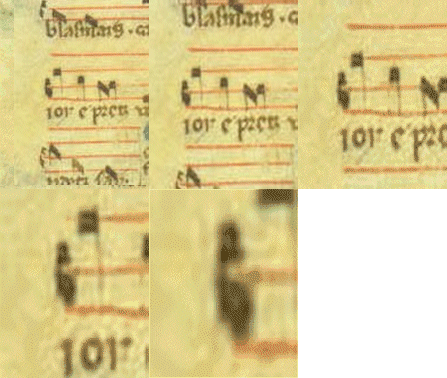
The history of writing music down, that is, of music notation, begins, for Western music, in the 11th century. It is a complex history. We take here one moment in that history represented in some 13th century manuscripts, especially those containing the Cantigas de Santa Maria by Alfonso el Sabio.
Part I: Staves and Clefs
By this time, a 5-line staff with a clef or clefs is in use for fixing pitches. Successive lines and spaces of the staff represent steps of the diatonic scale (the white keys of the piano). The clef shows the place of a specific pitch thus is the "key" to all the other pitches on the staff. Pitches are represented by notes. The goal of this lesson is to be able to distinguish the clef sign from the musical note forms and other signs also found on the staff. A later lesson will explain in more detail the way in which pitch is determined by the shape and placement of the clef.
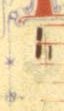
In general, the clef sign appears on the left-hand end of each line of musical staves, that is, at the beginning of each musical staff.
|
|
|
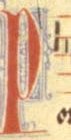
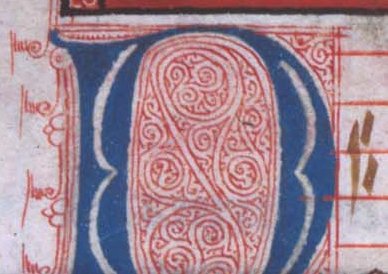
In cases where a large initial letter belonging to the lyrics of the song precedes the notation, the clef follows immediately after the initial.
 |
 |
Here are some examples of medieval clefs in multiple lines of notation:
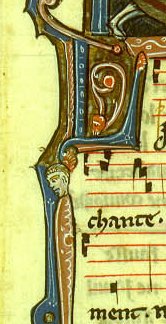 |
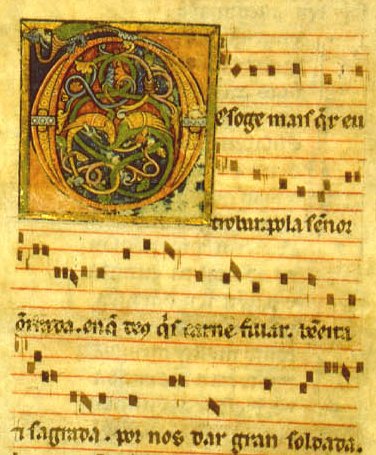 |
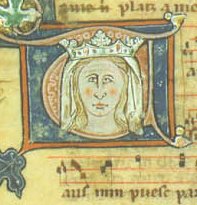 |
In some cases, the clef is closely accompanied by other elements, such as a "flat" sign (shaped, roughly, like a lower case "b"). These signs will be explored in a future lesson.
Part II: Notes
By the late 13th-century, the note shapes have become square. In some notations of the late 13th century, the notes indicate not only pitch but also duration - how long a pitch should be held in relation to other pitches. When duration is indicated precisely, the notation is called "mensural." In the Cantigas de Santa Maria, some, but not all, notes indicate duration. For this reason, this notation is called "semi-mensural." The goal of this lesson is to become familiar with the basic shapes of notes, their names, and some possible sounds for these notes.
The basic note shapes have the following names (click on the image to hear a possible sound):
 |
The punctum, a simple square shape |
 |
The virga,a square shape with a stem |
These notes are combined to form two- and three- note ligatures. A ligature "binds" two or more notes in a single symbol. (Click on the images to hear a possible sound):
  |
Two-note ligatures. |
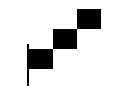 |
A three-note ligature. |
Each syllable of words to the Cantiga has a single note or a ligature.
Now, let's practice some of these shapes
and their sounds (Here and in the following pages, click on this
arrow to go to the next page of the exercise): 